

It’s October 17, 1989 and baseball fans all over the world are anxious for the crucial Game 3 of the World Series to begin at San Francisco’s Candlestick Park. It is the Oakland A’s vs. the San Francisco Giants. The Oakland A’s are up 2 games to 0. Game 3 is scheduled to begin at 1735 (5:35 P.M.) PST and TV networks are airing a pre-game show that began at 1700 (5:00 P.M.) PST. As the crowd of over 63,000 people began to take their seats in the stadium, they felt the stadium shake. At approximately 1704 (5:04 P.M.) local time, a magnitude 6.9 earthquake struck the coast of Northern California.
Side note: The Oakland A’s went on to sweep the San Francisco Giants 4 games to none. This makes me extremely happy, because I despise the Giants. 😀
Go Dodgers!
Anyways, back to the real material….
The epicenter of the quake was ~16 km (10 miles) northeast of Santa Cruz and the shaking lasted between 8-15 seconds long. There were 63 recorded deaths and about 3,700 people injured.
The fault that ruptured is part of the San Andreas fault system, but was composed of oblique-type motion. Oblique means that the fault ruptured in two different directions: horizontal and vertical. In this case, the fault block moved right laterally and the same fault block moved vertically as well (see figure 1). Despite the fault having oblique motion, there was no visible offset feature since the fault strand had no surface rupture.
On an interesting note, more than 63,000 people were at San Francisco’s Candlestick Park prior to the earthquake. One can argue that the World Series game saved lots of lives. Why and How? 5:00 P.M. on a Tuesday in a very populated California city is the prime recipe for heavy traffic where freeways are likely jammed with a ton of cars. With plenty of people attending the World Series game, traffic on major highways could have been much lighter than usual. A random, but neat, fact is the 1989 Loma Prieta earthquake was the first earthquake in the U.S. to have been broadcasted live on national television.
How awesome is that?
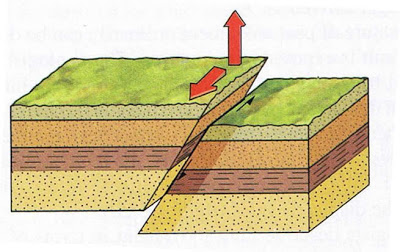
(Figure 1: Illustrates an oblique slip fault. The block to the left is the hanging wall, which has shifted in two directions as depicted by the red arrows. Photo: Civil Engineers today)
If you have any other questions, please feel free to contact me.
Again, thank you for reading.
Like, Share, and Subscribe for more earthquake blogs.
See you next time,
Bryan C.

 Earthquakes: A look at the Past