

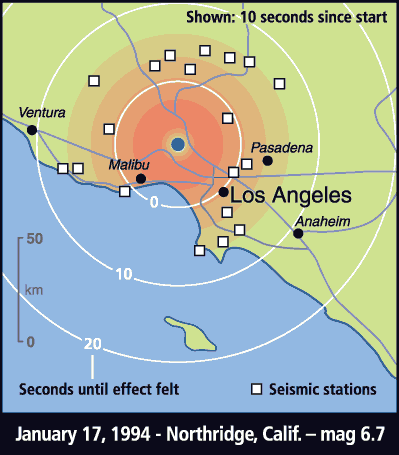
Today marks the 23rd anniversary of the 1994 Magnitude 6.7 Northridge earthquake. On January 17th, 1994 at 4:30 A.M. local time, the M6.7 earthquake struck the San Fernando Valley and shook the region for 10-20 seconds. This particular earthquake was no ordinary earthquake in the San Fernando Valley – it was also a discovery!
Initially, there was speculation that this earthquake was in fact the “big one” that Southern California still expects to occur; however, scientists were able to accurately determine the location of the epicenter. The epicenter was in the San Fernando Valley; thus, this earthquake was not generated by the San Andreas Fault.
According to the United States Geological Survey, USGS, there were 60 deaths, at least 7,000 people injured, more than 20,000 people were homeless, 7 sections of freeways collapsed, and a bare minimum 40,000 buildings that were damaged in Los Angeles, Ventura, Orange, and San Bernardino Counties. The maximum recorded acceleration was 1.8g approximately 7 km south of the epicenter, at Tarzana. This earthquake was so massive, that 4,000 square kilometers of the Earth’s crust became deformed due to the earthquake. The earthquake was felt across more than 200,000 square kilometers of area in the United States and Mexico. The Santa Susana Mountains sustained a maximum uplift of approximately 15 cm.
So what fault generated this earthquake and the subsequent aftershocks?
The fault that ruptured was an unknown fault until it made its presence known by producing these damaging earthquakes. Seismologists were able to determine that the epicenter of the earthquake was in Reseda near California State University, Northridge. There were two M6.0 aftershocks that occurred: one happened a couple minutes after the main event and the second approximately 11 hours after the main event.
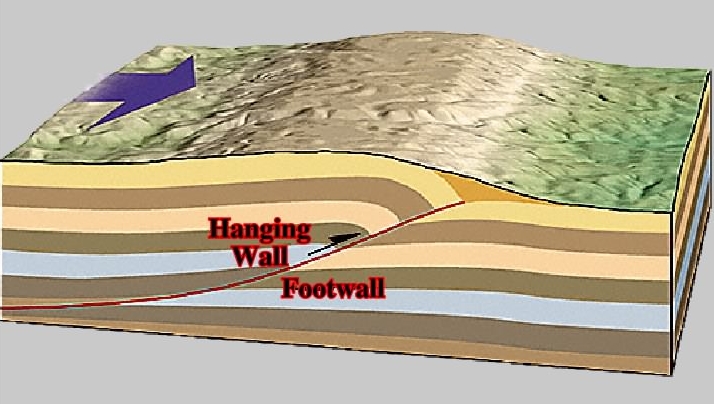
This fault is classified to as a “blind thrust fault.” We know that thrust faults consist of a hanging wall that is thrusted up over the footwall on the fault plane (Figure 3). The blind part comes in when the fault plane does not transcend to the surface. In other words, this low angle fault is deep underground with no hint of the fault on the surface of the earth. Thus, giving it the name “blind thrust.”
Scary isn’t it? Please enjoy these breathtaking photos of the 1994 M6.7 Northridge Earthquake results. If you find you are interested in other facts about the ’94 Northridge earthquake and the USGS response to the earthquake, click on the links below.
Earthquake Photos: http://www.laweekly.com/slideshow/northridge-earthquake-photos-from-1994-4314994/9
http://earthquake.usgs.gov/earthquakes/states/events/1994_01_17.php
https://pubs.usgs.gov/of/1996/ofr-96-0263/
If you have any questions, please do not hesitate to ask. And as always, thank you for reading.
Bryan C.

 Earthquakes: A look at the Past