1933 M6.4 Long Beach Earthquake

Today marks the 85th anniversary of the M6.4 Long Beach earthquake. This earthquake was significant to Southern California. This deadly quake occurred at 17:54 P.M. PST, about 5 km (3.1 miles) south of Huntington Beach. The Science: -The source of this quake was on the Newport-Inglewood fault zone. -These system of faults are right-lateral strike-slip faulting(Figure 1). -The epicenter was offshore with a depth of 10km (6.2 miles).     The bad stuff: -Approximately 120 deaths – $50 million in damage to buildings What did we learn: Several school buildings collapsed. It was particularly fortunate that this quake ruptured late … Continue reading 1933 M6.4 Long Beach Earthquake
1994 Northridge Earthquake

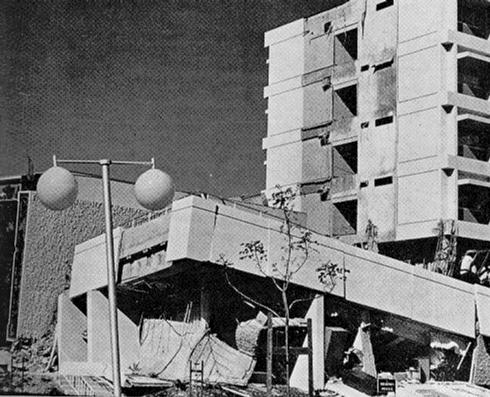
Today marks the 23rd anniversary of the 1994 Magnitude 6.7 Northridge earthquake. On January 17th, 1994 at 4:30 A.M. local time, the M6.7 earthquake struck the San Fernando Valley and shook the region for 10-20 seconds. This particular earthquake was no ordinary earthquake in the San Fernando Valley – it was also a discovery! Initially, there was speculation that this earthquake was in fact the “big one” that Southern California still expects to occur; however, scientists were able to accurately determine the location of the epicenter. The epicenter was in the San Fernando Valley; thus, this earthquake was not generated … Continue reading 1994 Northridge Earthquake

1989 Loma Prieta Earthquake

    It’s October 17, 1989 and baseball fans all over the world are anxious for the crucial Game 3 of the World Series to begin at San Francisco’s Candlestick Park. It is the Oakland A’s vs. the San Francisco Giants. The Oakland A’s are up 2 games to 0. Game 3 is scheduled to begin at 1735 (5:35 P.M.) PST and TV networks are airing a pre-game show that began at 1700 (5:00 P.M.) PST. As the crowd of over 63,000 people began to take their seats in the stadium, they felt the stadium shake. At approximately 1704 (5:04 … Continue reading 1989 Loma Prieta Earthquake

2011 Tohoku Earthquake

On Friday, March 11th, 2011 at 2:46 P.M., a magnitude 9.0 earthquake struck the eastern shore of Japan. According to written historic records, this particular earthquake is the 4th largest earthquake in the world. When trying to understand why an earthquake is large or devastating, it is helpful if you know where the hypocenter and epicenters are located. The hypocenter of an earthquake is the location where the earthquake originates underground. The epicenter of an earthquake is the point on the earth’s surface that is directly above the hypocenter. For the 2011 Tohoku earthquake, the hypocenter was about 29 km … Continue reading 2011 Tohoku Earthquake

Why Earthquakes? Why Blog?

Greeting everyone, My name is Bryan Castillo and I am currently pursuing my master’s degree in earthquake geology. I have always had a curious passion for earthquakes, which is why I decided to dedicate my life to studying earthquakes. I absolutely love teaching people about geology and I plan to pursue a Ph.D in order to one day teach at a University. A little bit about myself other than the known obvious; I enjoy playing, watching and following baseball. I look at baseball as more than just a sport. I tend to wonder about the physics behind hitting a homerun, the exact … Continue reading Why Earthquakes? Why Blog?

1872 Owens Valley Earthquake

  Around 2:30 pm on March 26, 1872, a magnitude 7.4-7.9 earthquake shook the Owens Valley. Approximately 27 people were killed. The constraint on the earthquake’s true magnitude is uncertain due to lack of seismic data (since there were no seismometers at the time). Based on paleoseismic data, geologists were able to narrow down the margin of error to confidently publish that the magnitude of the 1872 Owens Valley Earthquake was between 7.4-7.9. Regardless the fact, this was one of the strongest earthquakes to hit California in recorded history. The fault that ruptured that generated this earthquake is called “The … Continue reading 1872 Owens Valley Earthquake